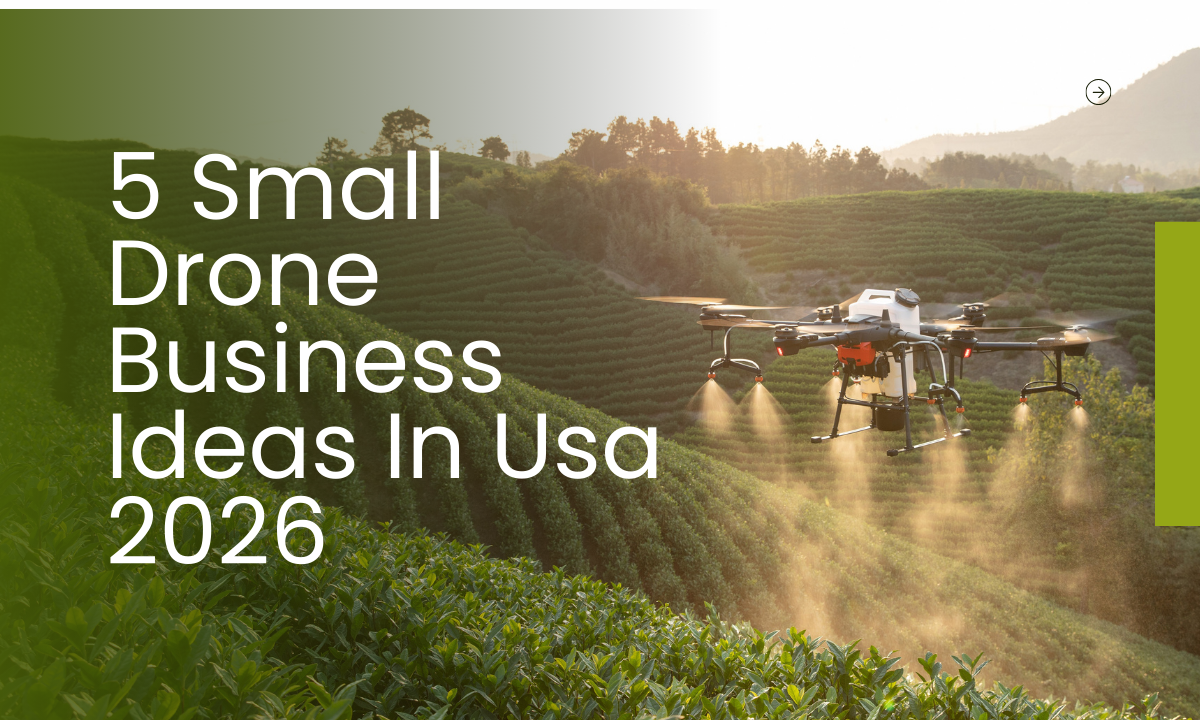
Small Drone Business Ideas In Usa 2026:- are gaining massive attention as drones become more affordable, regulations clearer, and demand for aerial data and visuals continues to rise across industries. In 2026, drones are no longer limited to large corporations or government agencies—small business owners and solo entrepreneurs in the United States can now launch profitable drone services with relatively low startup costs. From local service contracts to digital-first offerings, drones are opening new doors for scalable and location-independent businesses.
What makes small drone businesses especially attractive in the USA is the wide range of industries actively adopting aerial solutions. Real estate, construction, agriculture, insurance, media, and infrastructure companies are all looking for faster, safer, and more cost-effective ways to collect data and create visual content. With FAA Part 107 certification and the right niche focus, even a one- or two-person drone operation can compete effectively and generate consistent income in the American market.
In this blog post on Small Drone Business Ideas in USA 2026, we’ll explore practical, high-demand drone business opportunities tailored specifically for the U.S. ecosystem. Whether you’re a beginner drone pilot, a tech enthusiast, or an entrepreneur looking for a low-investment startup, these ideas will help you understand where the demand is, how to position your services, and how to build a sustainable drone business in the evolving U.S. economy.
1. Commercial Inspections (Infrastructure, Energy & Utilities)
Drone-powered inspections are replacing costly, risky, and time-consuming manual inspections across the U.S. Entrepreneurs can offer solar panel, wind turbine, bridge, cell tower, roof, and pipeline inspections using high-resolution visual and thermal imaging. These services help companies detect heat loss, corrosion, cracks, leaks, and structural weaknesses—without shutting down operations.
० Why it works in the USA:
The U.S. has massive aging infrastructure and rapidly expanding renewable energy assets. Utility companies and municipalities actively seek safer, faster, and data-driven inspection solutions.
० Profit Potential: High
- Recurring inspection contracts
- Enterprise and government clients
- Premium pricing for thermal analytics
० Pro Tips:
- Obtain FAA Part 107 certification
- Invest in thermal + LiDAR-capable drones
- Focus on compliance-ready reporting formats
2. Construction Monitoring & Site Intelligence
Construction firms in the USA increasingly rely on drones for site mapping, progress tracking, asset monitoring, volumetric measurements, and safety surveillance. Drone data enables real-time visibility for developers, contractors, and investors—reducing delays, disputes, and cost overruns.
० Why it works in the USA:
Large-scale commercial and residential construction projects demand transparency, documentation, and efficiency—especially in competitive urban markets.
० Profit Potential: Medium to High
- Monthly monitoring subscriptions
- Long-term developer partnerships
- Data integration with BIM and project software
० Pro Tips:
- Offer weekly/monthly reporting packages
- Integrate AI-based progress analytics
- Target mid-size contractors first
3. Real Estate, Media & Event Coverage
High-quality aerial photography and videography are now standard in luxury real estate listings, commercial properties, resorts, weddings, sports events, and large-scale public gatherings. Drone visuals significantly increase engagement, property value perception, and marketing ROI.
० Why it works in the USA:
The U.S. real estate and event industries are highly visual and marketing-driven. Agents and brands pay premium rates for cinematic aerial content that stands out online.
० Profit Potential: Medium
- Per-project service fees
- Upselling editing and branding packages
- Retainer contracts with agencies
० Pro Tips:
- Build a strong portfolio and social proof
- Specialize in luxury or commercial niches
- Bundle drone + ground video services
4. Precision Agriculture (AgriTech & Smart Farming)
Drone services in agriculture include crop health monitoring, NDVI analysis, yield estimation, irrigation planning, and targeted crop spraying. U.S. farmers use aerial data to reduce chemical usage, increase productivity, and improve decision-making.
० Why it works in the USA:
The U.S. agricultural sector is highly tech-driven and cost-sensitive. Precision ag solutions directly impact profitability and sustainability—making drones a valuable investment for farmers.
० Profit Potential: Medium to High
- Seasonal contracts with farms
- Data analytics and reporting add-ons
- Long-term partnerships with agri-cooperatives
० Pro Tips:
- Focus on high-value crops first
- Offer easy-to-understand farmer reports
- Combine drone data with AI insights
5. Mapping, Surveying & 3D Modeling
Drone-based topographic surveys, 3D models, digital elevation models (DEMs), and land mapping are widely used in urban planning, mining, land development, and environmental studies. These services are faster and more cost-effective than traditional surveying methods.
Why it works in the USA:
Urban expansion, infrastructure upgrades, and smart-city projects across the U.S. require accurate, up-to-date geospatial data.
Profit Potential: High
- Government and enterprise contracts
- Large-area mapping projects
- Repeat clients in planning and development
Pro Tips:
- Use RTK/PPK-enabled drones for accuracy
- Learn GIS and photogrammetry tools
- Target municipal and engineering clients
Final Words
Small drone businesses in the United States are perfectly positioned for long-term growth in 2026 and beyond. As industries increasingly rely on aerial data, automation, and visual intelligence, drones are becoming an essential business tool rather than a luxury. From infrastructure inspections and construction monitoring to agriculture, real estate, and mapping, the demand is strong, recurring, and scalable. What makes this space even more attractive is that many of these services can be started small—with one drone, one pilot, and a clear niche—then expanded into high-value contracts and long-term partnerships.
For entrepreneurs in the USA, success in the drone industry depends on specialization, compliance, and professionalism. FAA certification, industry-specific knowledge, and data-quality reporting matter just as much as flying skills. Those who focus on solving real business problems—saving time, reducing risk, and improving decision-making—will stand out in a competitive market. If you’re looking for a future-ready, tech-driven business with relatively low startup costs, a small drone business in 2026 offers one of the smartest opportunities in the evolving U.S. economy.
Frequently Asked Questions (FAQ)
Q1. Do I need a license to start a drone business in the USA?
Yes. You must have an FAA Part 107 Remote Pilot Certificate to legally operate drones for commercial purposes in the United States.
Q2. How much investment is required to start a small drone business?
A basic drone business can start from $2,000–$5,000, including a professional drone, insurance, certification, and basic software. Advanced services (thermal, LiDAR, mapping) require higher investment.
Q3. Which drone business idea is most profitable in the USA?
Commercial inspections, mapping & surveying, and construction monitoring typically offer the highest profit margins due to recurring contracts and enterprise clients.
Q4. Can one person run a drone business?
Yes. Many successful U.S. drone businesses start as solo operations and later scale by adding pilots, analysts, or specialized services.
Q5. Is the drone business future-proof in the USA?
Absolutely. With growing adoption in infrastructure, agriculture, real estate, and smart cities, drone services are expected to expand significantly through 2030, making it a future-ready business.